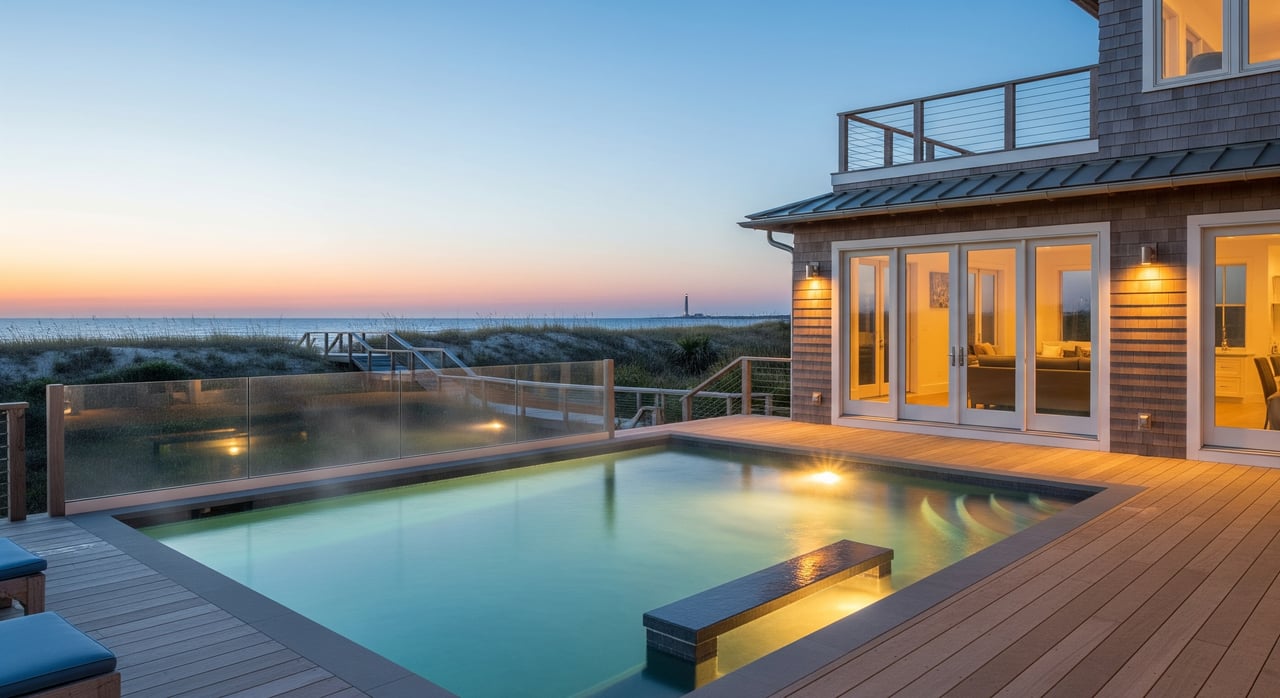
Cool ocean, warm bookings. That is the simple promise of pool heat on Hatteras. Spring and fall bring mild days, but the surf can feel brisk. If you want to fill April, May, September, and October, a heated private pool can tip undecided guests into “book now.” In this guide, you’ll see how Hatteras weather supports pool heating, what systems cost, how to set them up, and the best ways to market the amenity. Let’s dive in.
Why heat matters in Hatteras
Hatteras often enjoys comfortable shoulder seasons. Average highs run in the mid 60s in April and reach the low to mid 70s in October, with November still in the mid 60s. These conditions support efficient pool heat pump performance in spring and fall. Local climate data confirms this trend.
Ocean temperatures tell a different story. Sea temps commonly sit in the high 60s to low 70s in May and fall from the upper 70s to mid 70s in October, which can feel cool to many swimmers. A heated private pool becomes the dependable alternative when the ocean is chilly. See typical ranges at Cape Hatteras water temperatures.
Tourism demand is strong across Dare County, with visitor spending topping $2 billion recently, and local leaders are promoting shoulder-season stays. Even so, occupancy outside summer can be softer. Offering pool heat helps you capture those weeks when the weather is pleasant but the water and evenings are cooler. Review the local context in this Outer Banks visitor spending report.
Your pool heating options
Electric heat pumps
A pool heat pump moves heat from the air into the water. It is the most efficient option when air temps are moderate, which fits Hatteras shoulder months. Expect many hours to a couple of days for big temperature increases, so plan ahead. Typical installed costs often range from a few thousand dollars depending on capacity and coastal features, and operating costs are commonly cited in the tens to low hundreds per month in mild climates. See cost ranges at HomeGuide’s pool heater overview.
Propane gas heaters
Gas heaters warm water quickly and are helpful for fast ramp-up regardless of the weather. Upfront units can be affordable, but propane is comparatively expensive, so ongoing costs can be high if you run heat continuously. For rentals, factor in fuel delivery and tank management.
Solar thermal collectors
Solar pool heaters route water through sun-warmed collectors on a roof or rack. They have low operating costs and can be cost effective for extending spring and fall on sunny sites, especially when paired with a cover. Learn more from the U.S. Department of Energy’s guide to solar pool heating.
Hybrid approaches
Many owners combine systems, such as solar for baseline heating and a heat pump for control and reliability. If you choose any system for the coast, ask for corrosion-resistant, coastal-rated equipment.
What works best on Hatteras
Heat pumps align well with Hatteras shoulder months because daytime highs in April, May, September, and October often fall in the 60s to 70s. That keeps efficiency high. Gas delivers speed when you need quick heat, but fuel cost makes it better as a backup than a primary solution. Solar can carry sunny days and shoulder seasons and pairs well with a cover to hold heat overnight. For temperature context, see the local climate trend.
Costs and operating basics
- Installed cost ranges commonly seen in market surveys: heat pumps roughly from the mid thousands, gas heaters from the low thousands, and solar from the mid thousands depending on size and site. See summary ranges at HomeGuide and DOE’s solar pool heating overview.
- Operating costs vary with usage and rates. Heat pumps in mild weather often land in the $50 to $150 per month range reported by industry sources. Propane tends to be much higher if run continuously. Covers reduce run time and cost.
- If you are a Cape Hatteras Electric Cooperative member, check current residential and time-of-use options before you model operating costs. Peak hours and rates can change your math. See CHEC’s member portal for rate details: Cape Hatteras Electric Cooperative.
Permits, utilities, and vendors
- Confirm permits. In Dare County, mechanical, electrical, and plumbing work requires sub-permits and inspections. Plan for those steps in your budget and timeline. Start with Dare County Building Permits & Inspections.
- Plan power and fuel. If you choose propane, set up delivery and tank monitoring to avoid mid-stay outages. If you choose a heat pump or solar, verify electrical capacity and run times with your contractor.
- Choose coastal-rated equipment. Salt air accelerates corrosion. Ask for coated coils, titanium heat exchangers, and a placement that reduces salt spray exposure. Local pool and HVAC contractors familiar with OBX conditions can guide you.
Coastal durability and safety essentials
Salt, wind, and storms demand proactive care. Use corrosion-resistant models, rinse and service equipment regularly, and follow manufacturer guidance for winterization and hurricane prep. For cold-weather operation tips, see this manufacturer guidance on heat pump performance in cool weather.
A pool cover is the single biggest energy saver. DOE notes that covers can cut evaporation and heat loss dramatically, which reduces costs and extends your season. Learn more in DOE’s guide to swimming pool covers.
Safety matters in rentals. North Carolina requires barriers and safety measures for pools, and insurers often expect documented compliance. Review relevant public health statutes at the NC General Assembly site.
Make it pay: operations and ROI
Operational best practices
- Set pool heat for spring and fall windows. Start 24 to 72 hours before arrival to hit target temperature, then maintain during the stay. Guidance from manufacturers aligns with this timeline.
- Pair every system with a well-fitted cover. This step saves the most energy and protects your ROI.
- Offer pool heat as an optional add-on during shoulder months. Many rental managers list pool heat as a fee-based option for spring and fall so you capture revenue from guests who value it without raising all rates.
Simple ROI example
- Installed cost example: coastal-rated heat pump plus cover at about $6,000.
- Operating example: four shoulder months at an estimated $100 per month equals about $400 per year. Actual costs depend on CHEC rates and run time.
- Revenue idea: if pool heat helps you win four extra shoulder-season weeks at a $100 premium per week, that is roughly $400 in added revenue, with many owners capturing more when occupancy and average daily rate improve. Cost context and owner experience commonly support the investment case for a heat pump and cover. See a summary perspective on value here: Is a pool heat pump worth it?
Marketing your heated pool
- Use clear, guest-friendly language such as “private heated pool,” “pre-heated before arrival,” and “available in spring and fall.”
- Publish exact availability dates or by-request policies so expectations are clear. This mirrors common OBX manager practices highlighted in local FAQs like Outer Banks Blue.
- Show it off. Photos of evening swims and families enjoying the pool help convert shoulder-season browsers into bookings.
Ready to extend your season?
If you want a rental that performs beyond summer, pool heat is a practical, high-impact upgrade on Hatteras. Our team helps owners weigh costs, permits, and pricing against real local demand so you invest wisely. If you are planning to buy, sell, or optimize a rental on the northern Outer Banks, connect with Crystal Swain for rental-first guidance that helps your numbers and your guest experience.
FAQs
What months make pool heat worthwhile on Hatteras?
- Spring and fall are the sweet spot. Average highs in April and October often sit in the 60s to 70s, which supports efficient heat pump operation and makes a warm private pool a strong draw when the ocean feels cool. See local climate data at PlantMaps.
How fast can a pool heat up for arriving guests?
- Heat pumps generally need 24 to 72 or more hours to raise water by multiple degrees, so start early. Gas heaters warm faster but cost more to run. See a basic explanation of heat-up expectations here: How warm can a heat pump get your pool.
Do I need permits for a pool heater in Dare County?
- Yes. Mechanical, electrical, and plumbing work requires sub-permits and inspections, and pool installations have specific fees. Start with Dare County Building Permits & Inspections.
How much can a pool cover reduce heating costs?
- A lot. DOE guidance shows covers can reduce evaporation and heat loss by large percentages, which cuts run time and saves money. Learn more about pool cover savings.